Click here visit our Research-supported educational program for children
April 22, 2026
Fireside Chat Summary
Topic:
TRC meets EDI - The Performativity of Land Acknowledgements
Online Engagement check-in question:
Has there been a time in your lived experiences where you should have had an emotional response towards something but couldn't?
Engage more with our regular Fireside Chat members here in our Padlet:
Summary
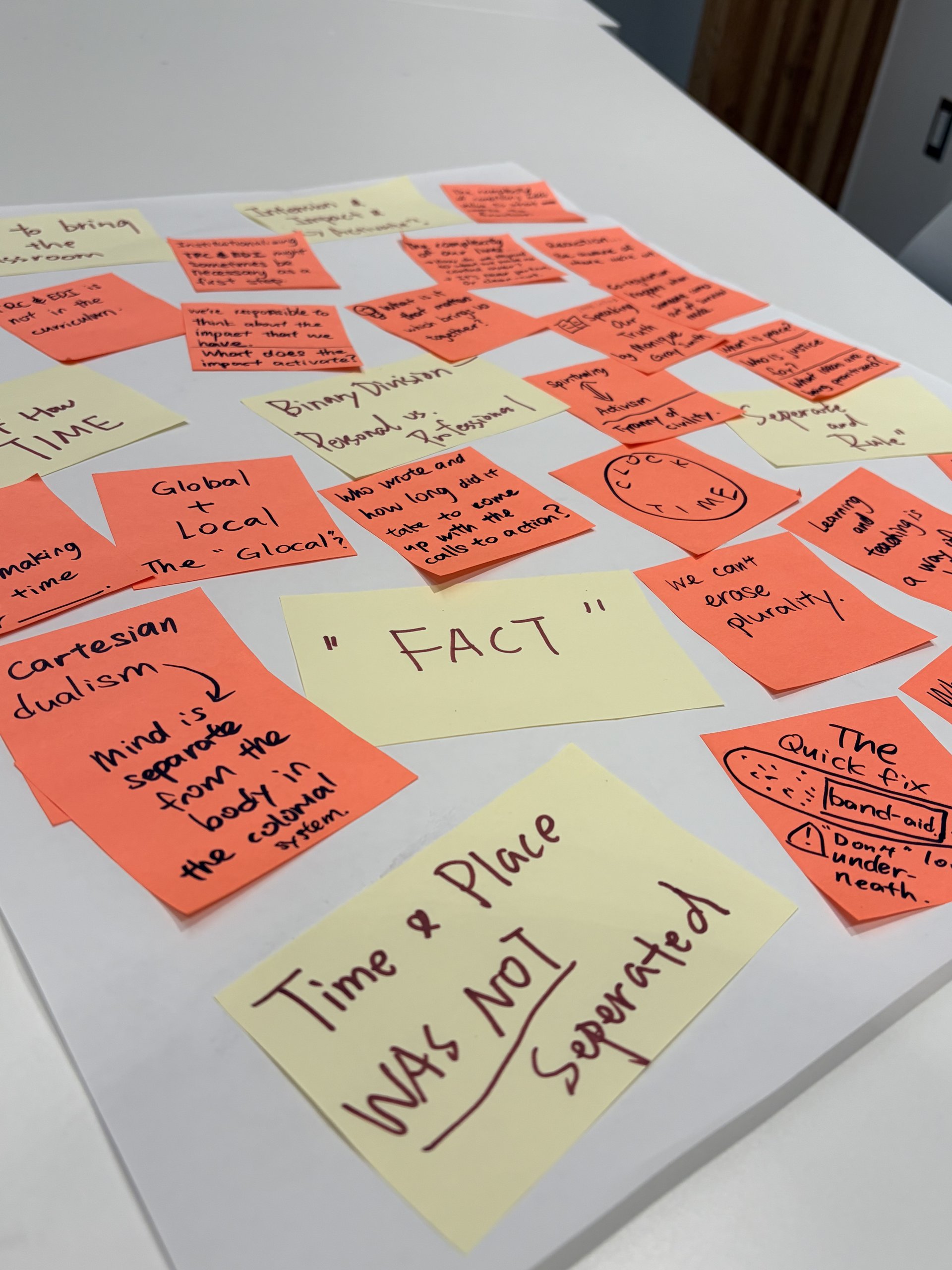
This Fireside Chat invited participants into a reflective dialogue on the disconnection between language and emotional experience within educational systems. Grounded in Building Stewardship Spirit’s relational approach, the conversation explored how colonial and institutional structures often separate thinking from feeling, shaping how learners engage with knowledge, themselves, and others.
Participants reflected on how education systems frequently prioritize performance, assessment, and outcomes over emotional engagement and relational understanding. This emphasis can lead learners to focus on producing correct answers rather than exploring how they feel, limiting opportunities for deeper connection to learning. The group considered how this disconnect may begin early and become reinforced over time through academically driven environments.
The discussion highlighted how students are often positioned as passive recipients of knowledge, with limited space to question, interpret, or emotionally engage with what they are learning. Participants reflected on how this approach can silence diverse perspectives and reduce the richness of classroom dialogue. In contrast, creating space for multiple viewpoints and encouraging learners to express uncertainty or difference was seen as essential for meaningful engagement.
Participants also explored the challenges of implementing alternative approaches within existing systems. While there is interest in fostering more relational and emotionally responsive forms of learning, institutional structures can make this difficult. The group reflected on the courage required to hold space for different perspectives and to engage in dialogue that may involve tension, discomfort, or disagreement.
The conversation emphasized the importance of critical thinking and relational listening. Participants discussed how educators can unintentionally reproduce dominant systems when relying on familiar tools and frameworks without questioning their underlying assumptions. This led to reflections on how to create learning environments that support both intellectual and emotional engagement while remaining attentive to issues of equity and inclusion.
A recurring theme was the role of mindfulness and presence in reconnecting words and feelings. Participants reflected on how cultivating awareness in everyday actions, speech, and interactions can support more intentional and relational ways of being. This included recognizing how disconnection from one’s body and emotional awareness can contribute to reactive or judgmental responses.
The discussion also touched on the complexities of engaging with Truth and Reconciliation efforts, including the tension between performative actions and meaningful engagement. Participants reflected on how understanding context and intention can deepen one’s approach to reconciliation, moving beyond surface-level practices toward more thoughtful and relational forms of participation.
Throughout the gathering, participants emphasized the responsibility educators hold in shaping how students relate to knowledge, emotions, and one another. Supporting learners in navigating both cognitive and emotional dimensions of learning was understood as an important part of fostering more holistic and inclusive educational spaces.
The session concluded with a shared recognition that reconnecting words and feelings is an ongoing process. Participants expressed both inspiration and a sense of responsibility in continuing this work, acknowledging that creating more relational and responsive educational environments requires sustained reflection, dialogue, and care.